Sunday, 5 April 2009

AFA - Brownsea Island (the beginning of BSA)


Back during the first week of August 1907 Lord Baden-Powell was looking for a place to try out his experimental program for young boys. He settled on Brownsea Island, an island owned by a friend of his. There he brought 22 boys and did activities to train them in skills such as camping, woodcraft and lifesaving. The program was a massive success. A year later Scouting For Boys (a re-write of his military manual on outdoor skills) was published and the international Scouting movement took off. A few years later Lady Baden-Powell created the girl version of the organization, and it has been growing since - in 2007, the anniversary year, it was estimated that there are 38 million Scouts world wide.
The island has gone through several owners eventually owned by the British National Trust. In 1963 49 acres - including the original Scout area - were given to the Scouts and was dedicated by Lady Baden-Powell. In August 2007 (one month before we got to the UK - rats!) they celebrate the 100th anniversary of Scouting on the island.

A bust of, and poster about, Lord Baden-Powell on the walk to the Scout center.


John and I standing on the very site of the first Scout Camp.

The Scout Stone - monument commemorating the founding of Scouts

A life sized (?) statue of Lord Baden-Powell on the dock where you catch the ferry to the island. He is actually wearing a pocket knife and Wood Badge beads.

An interesting sight from the ferry. The Haven Hotel is where Marconi lived when he perfected the wireless telegraph and transmitted over water the first time - from this hotel to a receiving point across the harbor.


Tuesday, 24 March 2009

Saturday, 21 March 2009

AFA - St Patrick's Day Weekend in Dublin (aka Baile Átha Cliath)

Dublin is the capital and largest city of the Republic of Ireland, not to be confused with that other country, Northern Ireland, which remains a part of the United Kingdom. The name Dublin comes from the combining of the old Irish words "dubh" (meaning black) and "linn" (meaning pool) because the river Liffey and another smaller one met there forming a black pool. Those that didn't know the language combined the two dropping the 'h' and extra 'n' to make the name Dublin. The preferred name in modern Irish is 'Baile Atha Cliath' ('The Settlement of the Ford of the Reed Hurdles') (there's a song title for you) - no clue how one might go about pronouncing it, but that is the name on some of the publc buildings and their license plates as you can see below.

The city is a very successful, modern, commercial centre, and one of the fastest growing areas in Europe. It is a very youth oriented, social, and expensive. It was the 2007 Friendliest City in the World. I'm told it is a destination of choice for a weekend of partying for college age kids.We certainly saw a ton of them there this weekend.
You can see evidence of some of that partying in this picture ... look closely

Touring the city is a stroll through a turbulent history, and unlike most of the rest of the places we have visited, this is very recent. There are statues all over town of Irish revolutionaries, most of whom died there in the last 100 years. One of the most popular tourist attractions is the Kilmainham Gaol (jail) where the leaders were imprisoned. We took that tour, and the cells still have their names on the doors. Interestingly, the very last prisoner there before they closed it was the man that became the first president of the Republic of Ireland in the 1920s, Eamon de Valera.

But the lasting impression of Ireland will be their jolly disposition. Maybe it is the drinking, but they certainly are witty.
Some examples ...

This 360 foot tower called "The Millennium Spire", built in 2003, is the world's tallest sculpture. The locals call it either "the Nail in the Pale" or the "Stiletto in the Ghetto." ("pale" refers to when the UK governed the northern part of Ireland down to Dublin, and called it 'the Pale') (plus it rhymed)
Interesting note: They built it in the exact spot where once stood a 100+ foot statue of the British war hero Admiral Nelson, very similar to the one in Trafalgar Square in London. The IRA blew it up in the 60's.


In a town known for drinking, it is hilarious that there would be a "Liver Assurance" company - which happened to be right beside a pub. Dublin is the home of Guinness, a very popular beer brand worldwide and the #1 most popular in Ireland. At one time Guinness was the leading employer in town - the founder, Arthur Guinness, is a local hero, donated much to the city, and his stature is in the garden at St Patrick's cathedral. Tours of the brewery are very popular and include samples, somehow we missed that one. There are about 1,000,000 people in Dublin, and they consume an average of 2,000,000 pints of beer per day. (Hence the need for Liver Assurance.)


I don't know what Oscar Wilde looked like, but I do know what Hugh Grant looks like. They think this is a statue of Oscar Wilde. Dublin has some wonderful statues of people all over town, but this was the coolest.


This skinny doorway leads to the smallest pub in Ireland, it will hold 20 - standing.


This is a statue of Molly McGuire. Also known locally as, 'The Dish with the Fish', or the 'Tart with the Cart.' Molly sold fish during the day and was said to be a 'sparkling conversationalist' at night.


This is the Bank of Ireland When they built the building there was a tax on window glass, so as you can see, they didn't use any. The Irish say when you put your money in the Bank of Ireland, it never sees the light of day again. (get it??)


The Dublin band U2 is one of the most popular bands in the world. The lead singer Bono and guitar player Edge co-own this hotel. The green top floor is a luxury penthouse where they stay when in town. The story goes that Larry Mullen, the drummer, decided to start a band in middle school right here in Dublin, and posted a notice at school for guys to join him. The other three guys showed up and the rest is history.


You'll only appreciate this if you have been to the Vatican Museum, but this is a smaller, but otherwise exact replica, of a statue in the courtyard of the Vatican Museum. Very cool sculpture.

St Patrick
St Patrick is the patron saint of Ireland and is revered for bringing Christianity to Ireland. He was Welsh and sent to Ireland as a missionary. Unlike other missionaries of his time, he didn't accept support from the rich royalty but lived the life of the common man and was accepted because of it. Not a lot is known about him, not even exactly when he lived, but they estimate it as about the 5th century. The two legends that persist about him are that he taught about the Father, Son and Holy Ghost by using the three leaf clover, or shamrock, to make his point - and
that he 'drove the snakes out of Ireland'. Scientists suggest that there were never any snakes in Ireland. Historians suggest that when they said 'snakes', they might have meant 'Druids'. (you can see how they might have been confused, they sound so much alike) Actually, the Druids used the serpent as a symbol in their rituals - so maybe that really was it. This is a picture of the St Patrick's cathedral, and the fountain in the garden marking the spot where St Patrick did baptisms. We never got inside to look around, both times we came by they were using it for religious services. Imagine that!


Happily, the teacher's workday at ACS coincided with St Patrick's Day weekend, so we were actually there for the celebration. They say the 4-day celebration in Dublin is the SECOND largest St Paddy's Day celebration in the world - behind only New York City. (more Irish here, more thirsty Irish pretenders there) They had parades, carnivals, fire works, shamrocks everywhere, people wearing green paraphernalia, McDonald's sold green milkshakes (but were sold out when we went), and live music in the streets - if I can get it to upload on our lame internet connection, I have video of one of the bands. I loved getting to hear the band, and seeing the Irish dancing. (look ma, no hands!)

Saturday, 21 February 2009

AFA - Vienna Austria (no kangaroos) February 2009


(a picture of the hat I bought - clearly Austria has a sense of humor - the "Austria, no kangaroos" logo was very common)

Well, it was mid-term school break, time to hit the road again!! Last year at this time we did the Germany, Switzerland, Holland loop. This time we decided to hit three major cities in Eastern Europe, Vienna, Prague and Budapest. We flew into Vienna, got a family room and used it as home base for the whole 9 day trip. That was nice, it allowed us to just take overnight bags to Prague and Budapest.

Vienna used Euros (1.25 = 1$) and spoke German, Prague used Crowns (20=1$) and spoke Czech, and Budapest used Forints (200=1$) and spoke Hungarian. So including the UK pounds in my pocket, I was carrying four different types of currency at one time or another. You should have seen the look on the faces when I accidentally would try to spend an inappropriate bill. It was very confusing to figure out the best prices.

The people were incredibly friendly, often approaching us and offering directions. The first day there a very large, scruffy young man approached John and I while we were waiting for the girls to get ready. I was very uncomfortable, fearing the worst. He just came up and said in pretty good English, "Can I help you find something?" When I told him we were just waiting for the rest of the family, he proceeded to point out some of the nearby sights and then just walked away.

One characteristic that fit all three was the buildings had style. Even many of the more mundane buildings had little touches of class that made each of the three cities very beautiful and "old world" feeling. To honor that, I am adding a "miscellaneous pictures" section to the bottom of each of these three posts.

Haydn Hotel
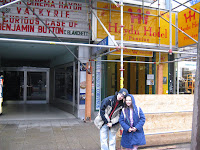
Here's where we stayed. Despite the appearance of the scaffolding outside, it was perfect. It was a block from the 'U-Bahn' (subway), in the middle of the biggest shopping district in Vienna (called Mariahilfer strasse), and reasonably priced. A weird coincidence, as you can see there is an English language movie theater next door. Right next to the theater there was also a small, but incredibly ornate on the inside, church who's bells rang incredibly loudly early Sunday mornings. Notice the statue of Haydn in front.

The House of Music
Vienna (called "Wein" locally, pronounced "veen") is known for music, with the Strauss family, Haydn and Brahms being from there. There was a hands on museum about the major composers.
The coolest exhibit was the one pictured below, at which (using Wii-like technology) you have the opportunity to conduct the Vienna Philharmonic Orchestra. You pick a song off the menu and hold the baton, and conduct. The orchestra follows your lead, as slow or fast as you conduct. But, if you go too slow or too fast for too long, the orchestra puts down their instruments and yells at you in German. Hilarious!


Trinity Column / Plague Monument
Europe was devastated by the plague 400 years ago, and each of these cities have monuments to those who died and to indicate the gratitude of the survivors. One third of Vienna died.


Ferris Wheel
This is in the Prater, a park donated by the emperor Franz Joseph to the people. It is 100+ years old and over 200 feet tall. Great views from the top. Each of the wooden "cars" are shaped like train cars and will hold about 30.


Charles Church
This is a "votive church", a gift to honor someone. This church is dedicated to a local Bishop (want to guess his name?) that served the people of Vienna during the plague.
The really interesting thing about it is the opportunity to go up to the painted dome while it is being restored. You can see how they distort the pictures in order that they look normal 200 feet below. Note how they look a little squashed in order that they look proportionate from the floor.


St Stephen's Cathedral
It seems that every European city has one of these massive, skyline busting cathedrals and Vienna is no exception. St Stephen's is Austria's national cathedral. It was damaged in the second world war and the roof had to be replaced. For donations, you got your own tile to be placed on the roof. Hence the colorful tiled roof that otherwise makes no sense with the architecture. The view from the tallest tower is incredible, but you earn it by climbing 343 steps!

Two different Hofburg Palaces - Amazing Religious relics
Vienna was the home of the Holy Roman Emperor (HRE), both king and the pope. As such, these guys lived pretty good. But they also had a passion for religious artifacts and the influence to get them.
In the first row you see the crown of the HRE. Interestingly, we saw many portraits during our visits to these cities, and if the picture contained the HRE, he was wearing this same crown.
But even more amazing is their claim about the next items. Pictures were discouraged, but Mom pulled out the cell phone to capture these, hence the lesser quality - but still very interesting shots.
The first picture is of a gold, jewel encrusted cross. The back of the cross had a hidden compartment designed to hold the next two items.
The second picture is the spear that pierced His side on the cross.
The third picture, the cross shaped item, is a metal container. The vertical piece of wood in it is a piece of His cross, complete with a nail hole.
Astounding, if real.


Viennese Chocolate!!!
It would be a catastrophe to miss that. Each of these displays in the chocolate shop window are made of chocolate. As you will see in the last picture, the catastrophe was averted - more than once. The specialty is called 'sachertorte', basically chocolate cake. The Allens don't miss excuses to eat chocolate cake! (nor did we want to hurt any feelings)


Another Palace - Used as the Natural History Museum


Classy public toilets

The story behind these unique, luxurious, toilets is that around 1900 a local entrepreneur wanted to convince the public that he had a chemical concoction to really get bathrooms clean, so he bought two wine cellars and hired Vienna's most famous architect Adolf Loos to make them into public toilets. (get the irony? Adolf Loos built two loos?) They are really nice, and free.


Funny Shots
First, Vienna (being the classy town that it is) had the classiest McDonald's we've ever seen! And second, horse drawn carriages were popular. Looking carefully you can see they even carry a bucket to pick up their 'leavings.' This particular carriage must have been in a rush, because you can see a 'gift' by the back left wheel. They didn't stop.


Miscellaneous buildings that caught our eye ...